Bleached coral recovers after touching a healthy clone, Stanford lab finds
A chance tumble in a Stanford tank revealed that healthy coral can pass colour-giving algae to a bleached genetic twin, restoring it within about two weeks.
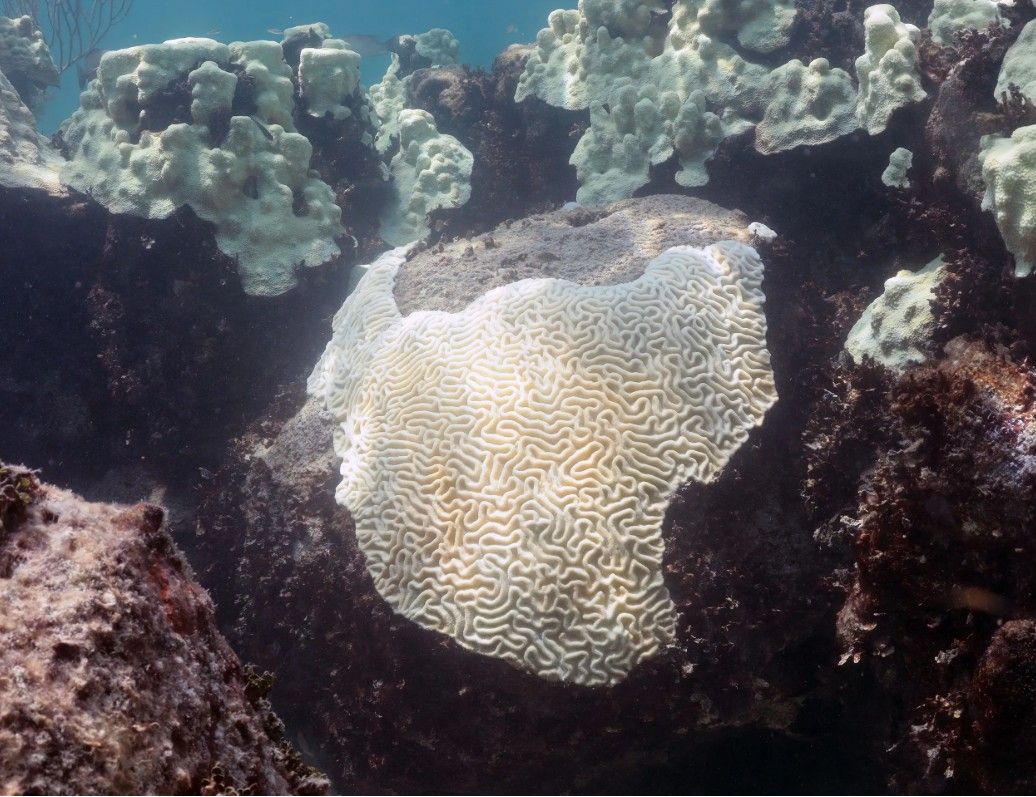
A happy accident in a Stanford laboratory has shown that bleached coral can be nursed back to health by a healthy neighbour. Two coral fragments toppled over in a tank and ended up touching. Within days, the bleached one had begun to recover.
Bleached coral has lost the symbiotic algae that give it both its colour and its nourishment. Here, researchers watched the healthy fragment send its algae across to the pale one. After a couple of weeks, the two could not be told apart. “We were blown away,” said ocean scientist Danny Collins.
The work, published in Science Advances, suggests that bleached coral is not necessarily a lost cause, and that it can bounce back faster than scientists had expected.
The effect rests on two conditions: the fragments must touch, and they must be genetically identical. When Collins’s team kept them a few millimetres apart, nothing happened. Corals from different genetic backgrounds simply rejected one another.
Genetic clones, by contrast, fused. Their tissues formed a bridge, which Collins likens to a nutrient highway, carrying algae and nutrients from the healthy coral to the bleached one. Coral is a colonial animal made up of thousands to millions of polyps, so the ability to merge probably helps a piece broken off by a wave to rejoin its original colony.
This is early laboratory research, and it has yet to be tried on a living reef. Julia Cole, a coral scientist at the University of Michigan who was not involved, called the findings a glimmer of light. She also noted that reefs run for kilometres, so a method needing coral-to-coral contact would be painstaking work.
Collins’s team is therefore pursuing another route. They are working on taking algae from healthy reefs, growing it in laboratories and placing it on vulnerable reefs before bleaching is expected. Their hope is to develop treatments that could be used in the field and eventually scaled up.
Why it matters
The International Union for Conservation of Nature has warned that roughly 96 per cent of shallow-water reef systems are in critical danger and might be gone by 2075. Reefs shelter up to a third of marine species, and the fishing and coastal economies tied to them sustain hundreds of millions of people. Any new way to help bleached coral recover is a welcome boost, though Cole was clear that restoration does not deal with the warming oceans behind the problem, which means cutting greenhouse gas emissions.